
Oct 7, 2026Home Routines
Camera Earbuds in 2026: B2B Sourcing Guide & Market Trends
Camera earbuds pair open-ear audio with an 8MP POV camera. 2026 market evidence plus MOQ, certification and privacy checks before you source.
Camera Earbuds in 2026: A Sourcing Guide for Wholesalers and Brand Owners
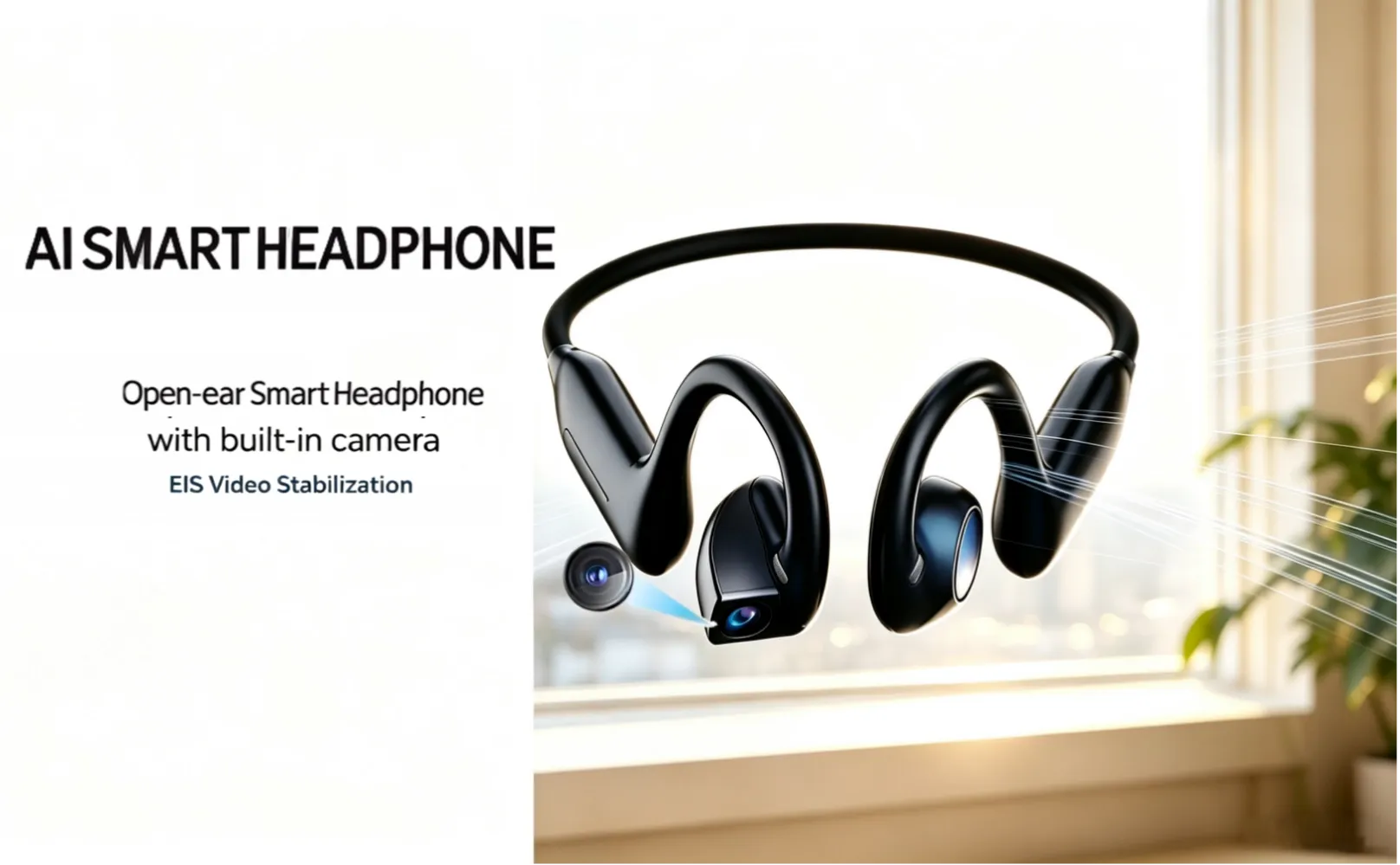
Camera earbuds look like an ordinary pair of open-ear earbuds until you notice the lens. A small camera sits in the ear-hook shell, and an AI layer in the companion app handles image recognition, translation and voice-activated capture. Sold as AI camera earbuds or simply earbuds with a built-in camera, the category is moving from trade-show curiosity to something buying desks now plan shelf space for. This guide is written for wholesalers, brand owners and marketplace sellers. It covers what the product actually is, what the 2026 data says, how it compares with camera glasses and action cams, and the checks we would run before wiring a first deposit.
What Are Camera Earbuds?
Three products share one housing. First, an open-ear earbud: the speaker rides on a hook outside the ear canal, so the wearer keeps full awareness of traffic, colleagues and announcements. Factories call these OWS earbuds, short for open wearable stereo. Second, a camera module small enough to disappear into that hook, typically shooting 8MP stills and 1080P video. Third, the AI layer in a companion app: point the lens at a plant, a landmark or a block of text, and the app identifies it, translates it or logs it.
The category is not camera glasses, which hide the sensor in a spectacle temple and still need prescription-lens fitting like any pair of frames. It is not an action cam either. Action cams are larger, mount on a helmet or chest, and record at far higher image quality. Camera earbuds sit at head height, a little below true eye level, and trade image quality for one advantage: the device is already on your head when the moment happens.
Why the Category Is Moving Now: Three Data Points
Three data points explain why this category now earns buyer meetings instead of polite nods.
EssilorLuxottica, the group behind Ray-Ban and Oakley, disclosed in its full-year results, reported in February 2026, that it sold more than 7 million pairs of Ray-Ban Meta and Oakley Meta AI glasses in 2025. The two lines moved roughly 2 million units combined across 2023 and 2024. That is not a niche clearing stock. It is mainstream eyewear retail absorbing AI camera wearables at scale.
Shipments are forecast to keep climbing. IDC projects global smart glasses shipments of about 13.6 million units in 2026, up roughly 41 percent year over year, on a path toward some 27.3 million units by 2030. Whatever hardware wins, the demand curve points up.
Then there is Apple. Bloomberg reported, and Tom's Guide picked up, that AirPods Ultra earbuds with built-in cameras and an H3 chip are in development, now reportedly delayed to 2027. Reporting suggests Apple's cameras would read the environment rather than shoot it, which is a different job from photography. For a sourcing decision, that detail matters less than the program itself: when the largest audio brand on the planet puts cameras on earbuds, the concept stops needing an explanation in a buyer meeting.
Camera Earbuds vs. Camera Glasses vs. POV Action Cams
Buyers comparing these three form factors usually start with the camera. That is the wrong place to start, because only one of them is really a camera product. POV action cams exist to shoot video. They win on sensor size, frame rates and stabilization, and nothing wearing an 8MP sensor will out-shoot them. If your customer's use case is action-sports footage for a YouTube channel, sell them an action cam.
Camera glasses are eyewear first. The camera hides in the temple, and the frames still have to fit a face, which means prescription-lens fitting, returns for wrong prescriptions, and SKU depth across lens powers and face shapes. That is a retail operation as much as an electronics one.
Camera earbuds sit between the two. The lens rides at head height, a bit below true eye level, so footage lands close to what the wearer actually sees. There are no prescription lenses involved and no face-fit matrix, and the audio function gives the device a daily job even when nobody is shooting. From a reseller's point of view that matters: a product worn for music on the commute gets worn for the camera when it counts. A hands-free POV camera that also plays music is an easier inventory story than a camera pretending to be eyewear.
We will use our own hardware as the worked example through the rest of this guide. Our E900 pairs an open-ear ear-hook design with a Sony IMX219 sensor shooting 8MP stills and 1080P video with software EIS, a 16mm open-ear driver, and 8GB of onboard storage that syncs over WiFi 6. We will keep model talk brief; the category logic is what matters for your catalog.
Use Cases That Actually Sell at Retail
Categories earn shelf space when a specific person has a specific problem. Four scenes keep coming up in buyer conversations.
Cycling commuters are the clearest. A rider in city traffic wants ears open for car horns, and if a driver clips them or a crash happens, a head-mounted camera is evidence with a timestamp. The same unit that plays a podcast on the way home records the incident. The footage matters less as a legal instrument than as a record and a deterrent. Cyclists ask for it anyway, and the safety story sells.
Runners and creators buy the hands-free angle. Nobody jogs holding a phone at eye level. An earbud with a camera shoots the trail, the finish line or the cooking process from the wearer's actual viewpoint, which is the POV footage that short-video platforms reward.
Travel is where the AI layer earns its place. Point the lens at a menu or a street sign and the app reads it aloud; simultaneous interpretation turns a taxi negotiation into an actual conversation. Sellers who already list AI translation earbuds can extend the line without teaching customers a new habit.
Meetings round it out. A voice memo on a triple-press, or auto-generated minutes through the app, covers the weekday office case, which is exactly when the device is already on your head.
The Buyer Checklist Before You Source
Before you wire a deposit, put these questions to every camera earbuds supplier on your shortlist and compare answers in writing. Ask any factory sales team what lands first on a WeChat call, and the answer is almost never megapixels. It is paperwork.
- MOQ and mold status. Ask whether the product runs on an open white-label mold or a private one, the MOQ per color, and unit pricing at 500, 1,000 and 5,000 pieces. Open-mold launches move faster; private molds protect your differentiation but tie up cash in tooling.
- Certifications. CE, FCC and RoHS at minimum for the EU and US. Ask for certificates with report numbers you can verify, not logo images, and confirm the Bluetooth listing if you plan to use Bluetooth branding.
- Recording indicator light. A dedicated light that flashes during capture is fast becoming a baseline expectation. Confirm it is enforced in hardware and cannot be switched off in firmware or the app.
- AI model dependency. Ask which large models power recognition and translation, whether features route through a paid subscription, and what end users lose if a provider changes terms or a region restricts access.
- Storage and sync. Onboard storage with WiFi sync matters more than most first-time buyers expect. Capture should work with no phone nearby, then upload when the device reconnects.
- Battery and clip limits. Small cells mean short recordings. Ask for the maximum single-clip length and the low-battery cutoff; on current-generation hardware, ten minutes per clip is typical.
- After-sales path. OTA firmware updates, warranty terms, and how spare charging cables reach your customers after launch.
Privacy Positioning Is Part of the Product
The fastest way to get a wearable camera delisted is to treat privacy as fine print; the second fastest is a disclaimer nobody reads. Your listing should do the opposite and put consent at the center of the product story.
In the United States, more than ten states, among them California, Florida, Illinois and Pennsylvania, require the consent of every party before anyone records a private conversation. Courts bar cameras from courtrooms, and employers increasingly restrict recording in sensitive workplaces. None of this blocks the category; it shapes how you sell it.
This is where the recording indicator light becomes a selling feature instead of a design leftover. On our example device, a dedicated white light flashes once for a photo and breathes during video, visible to anyone nearby.
Put that behavior in your listing photos. A Walmart listing that shows the indicator glowing during capture answers the privacy question before a reviewer asks it, and it gives your compliance story something concrete.
Honest Limits of Today's Camera Earbuds
Two limits will generate most of your support tickets, so write them into the product description up front.
First, image quality. An 8MP sensor shooting 1080P video is a capture device, not a cinema camera. It reads a sign in daylight at walking distance; it will not match a GoPro at dusk, and software stabilization only smooths what the sensor sees. Market the footage as POV documentation rather than production video and your return rate will behave.
Second, clip length. The small battery that keeps an earbud an earbud caps continuous video. Current devices top out around ten minutes per clip, and most stop recording before the battery runs dry. That is less of a problem than it sounds, because the use cases above are moment-based. Nobody needs forty minutes of a bike commute; they need the two minutes that mattered.
Reframe both limits as features. Clip-based capture with a mandatory indicator light is the opposite of continuous surveillance, and saying so plainly is what gets camera earbuds past front desks, office managers and skeptical relatives.
Next Step: Request the Sourcing Brief
If the category fits your catalog, the next step is paperwork, not a pitch. Request the sourcing brief and we will send the full specification, the certification package outline, MOQ and pricing tiers, and the customization options for your market.
You will be dealing with the camera earbuds manufacturer directly: the factory that builds the unit, holds the mold and answers certification questions in writing.
Request the E900 sourcing brief. Send your RFQ via [RFQ page URL to be inserted] with your target market, expected volumes and listing channels, and we will reply with the brief, realistic lead times and a straight answer on what we cannot do.