Oct 29, 2026Buying Guides
Camera Earbuds Wholesale in 2026: A Source-Factory Guide to the E900
Hot Selling Newest Product
By the SmileSam product team · Updated October 2026*
Camera earbuds have crossed the line from trade-show curiosity to a product that can earn shelf space. The pitch is simple: open-ear audio you can wear all day, plus a camera at head height that captures a moment without asking the customer to hold up a phone. For wholesalers, distributors and brand owners, the hard part is not the concept. It is choosing the right unit, the right supplier and a landed cost that leaves room for margin, while knowing what will come back as a return.
This guide is for buyers sourcing camera earbuds wholesale, not for consumers. It covers why the category is moving now, what the E900 does in practice, which channels fit it, how factory-direct sourcing changes the deal, and what to verify before you place a purchase order. It also states the limits plainly, because a product that is oversold in the listing is a product that comes back at the returns desk.
At a glance: With Sony IMX219 8MP camera · 1080p video with software stabilization · 8GB onboard storage · Wi-Fi 6 transfer · 16mm HiFi driver · three-microphone array · 220mAh battery · 1-10 minute clips · dedicated white privacy light · AI translation and meeting minutes · black, white or orange.
Why the Camera Earbud Category Is Moving Now
Three signals explain why this category deserves a buyer meeting rather than a polite nod.
Smart glasses proved that consumers will wear a camera. EssilorLuxottica sold more than 7 million AI glasses in 2025, more than triple the roughly 2 million units it sold in 2023 and 2024 combined, according to its full-year results reported on February 11, 2026. That is not a niche clearing stock. It is mainstream eyewear retail selling a camera-equipped wearable at scale.
The forecast still points up. IDC expects 13.6 million display-less smart glasses — AI glasses without a screen — to ship in 2026, up 41.4% year over year, on the way to 27.3 million units by 2030. Camera earbuds are a separate form factor, but they serve the same demand: an AI assistant that sees what the wearer sees without putting a screen in front of their eyes.
Apple's reported plan validates the concept, not the capture use case. Bloomberg's Mark Gurman reports that camera-equipped AirPods have slipped to late 2027, and that their infrared cameras are intended to feed Visual Intelligence rather than take photos or video. That distinction matters for positioning. Apple's reported entry would normalize the idea of a camera in an earbud; the E900 goes further by letting the wearer capture photos, video and audio, which is the job retail customers pay for today.
There is also a form-factor argument that glasses cannot answer. Camera glasses need lens fitting, frame inventory and a customer willing to change their eyewear. Camera earbuds need none of that. They fit a habit people already have — headphones for the commute, calls and workouts — and the camera is there when a moment happens. In our own order book, the E900 has been one of our fastest-moving open-ear models of 2026. The buyers are often already selling open-ear audio and want a higher-value step-up without teaching their customers a new category.
What the E900 Is
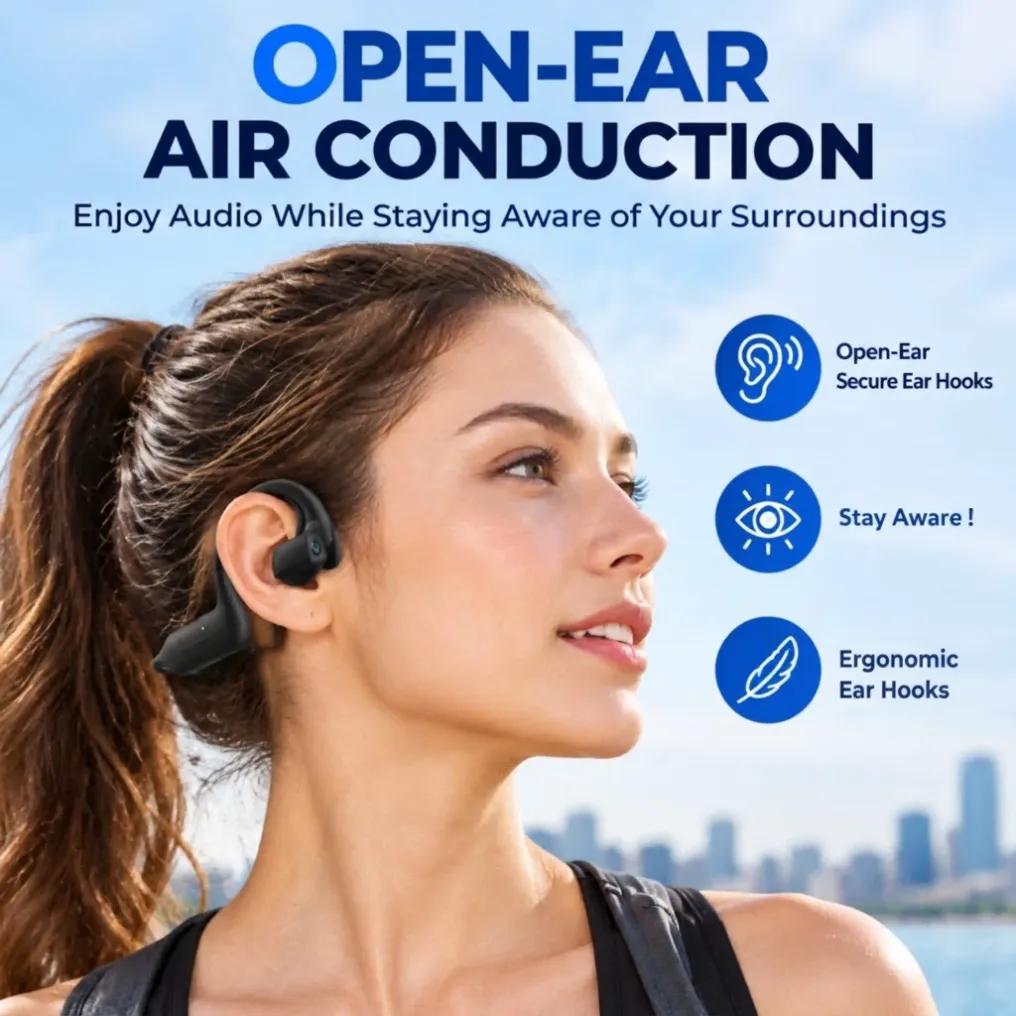
The E900 is an open-ear AI camera headset with an ear-hook design and a camera built into the housing. With A Sony IMX219 sensor captures 8MP stills and 1080p video with software stabilization. 8GB of onboard storage means capture works without a phone nearby; Wi-Fi 6 handles the transfer when one is nearby. Audio comes from a 16mm HiFi driver and a three-microphone array, powered by a 220mAh battery over magnetic dual-pin charging. One physical button handles power and capture; a touch strip handles playback, tracks and volume.
The companion app is where the AI layer lives. It supports visual recognition (describe an object, identify a car, estimate the calories in a meal), simultaneous interpretation, conversational translation and meeting minutes, with Tongyi Qianwen and OpenAI models behind the scenes. A wake word — "Hi, Luma" — triggers the assistant, and the hardware includes a dedicated white shooting light so people nearby can see when capture is active.
Specification | E900 |
|---|---|
Form factor | Open-ear ear-hook headset |
Camera | With Sony IMX219, 8MP stills |
Video | 1080p with software stabilization (EIS) |
Storage | 8GB onboard |
Transfer | Wi-Fi 6 for photos, video and audio |
Audio | 16mm HiFi driver; three-microphone array, -38dB ±1dB |
Battery | 220mAh; magnetic dual-pin charging; air and sea shipment with MSDS support |
Controls | 1 physical button (power, photo, video, audio); touch strip (play/pause, previous/next track, volume) |
Clip length | 1, 3, 5, 7 or 10 minutes, set in the app |
Privacy light | Dedicated white shooting indicator: one flash for a photo, breathing for video and audio |
AI features | Visual recognition, simultaneous interpretation, conversational translation, meeting minutes, audio/video calls, voice assistant |
AI models | Tongyi Qianwen and OpenAI, through the app |
Colors | Black, white, orange |
Operating temperature | 0°C to 55°C |
First-run note | Capture buttons are disabled until the unit has been paired with the app once |
Button logic is simple enough to demo in a store: one press takes a photo when idle, two presses start video, three start an audio recording, and a single press stops an active recording. One caveat for retail: on first power-up, capture is disabled until the unit has been paired with the app once. Configure every demo unit before it reaches the sales floor.
Six Features That Make the E900 Easy to Sell
1. It earns wear time as an ordinary headset. The 16mm driver and open-ear fit make the E900 a daily audio product first: podcasts, calls, music, workouts. Wear detection is supported, and the open-ear shape is designed for extended wear rather than a quick shot. A camera-only gadget gets used a few times a month; an earbud that plays music gets worn every day, which is what makes the camera useful when something happens.
2. The camera is credible for point-of-view footage. The Sony IMX219 is an 8MP sensor, and 1080p with software stabilization is enough for social clips, commute evidence, site inspections and travel memories. It is not a cinema camera, and buyers should not position it as one. Position it as hands-free POV documentation and the product meets expectations.
3. Capture works without a phone. Many low-cost camera wearables need a phone connection to record. The E900 records to 8GB of internal storage while disconnected, then syncs over Wi-Fi 6 when the phone is back. That difference decides whether the product works on a bike, on a run or on a factory floor.
4. The audio hardware supports the AI story. A three-microphone array, a 16mm driver and touch controls make the E900 usable for calls and voice commands, not just playback. AI features live or die on audio quality, so this is not a spec to skip in the listing.
5. Privacy is visible by design. The white shooting light flashes once for a photo and breathes during video or audio recording, while a separate tri-color status light handles pairing, charging and power. Put that light in your listing photography. It answers the first question a retail customer asks about a camera on someone's head, and it gives your compliance story something concrete to point to.
6. The app gives retail staff a thirty-second demo. Point the camera at an object and ask the assistant to describe it; switch on conversational translation for a face-to-face exchange; start a meeting note and let the app summarize. A demo that lands in thirty seconds is worth more on a store floor than a spec sheet. The three standard colors also give you a merchandising story beyond a single black SKU.
Who Buys It, and Where It Fits
Camera earbuds are not one product for one customer. Five buyer profiles keep coming up in buyer conversations, and each one implies a different channel.
Cycling and commuting. A rider in traffic wants ears open for horns and a camera at head height if something goes wrong. The same unit plays a podcast on the way home. Bike shops, commuter-gear stores and safety-focused catalogs are natural placements, and the safety angle sells without overclaiming image quality.
Running and outdoor creators. Nobody runs holding a phone at eye level. The E900 captures the trail, the finish line or the cooking process from the wearer's actual viewpoint, which is the footage short-video platforms reward. Sports chains, running stores and creator-gear e-commerce fit here.
Travel and language. The AI layer supports face-to-face conversation through the app, and the camera can capture a menu or sign for visual recognition. The open-ear fit keeps the traveler aware of announcements. Travel retail, airport electronics and language-learning catalogs can merchandise translation as the lead benefit.
Office and field work. Audio and video calls, voice memos and meeting minutes cover the weekday use case, while the camera handles inspections, site notes and documentation. Corporate gifting and B2B procurement can expense the unit as a headset first.
General consumer electronics. For Amazon sellers and electronics chains, the category sits between open-ear earbuds and action cameras. At the time of writing, 8MP camera earbuds on Amazon and crowdfunding platforms retail at roughly 130. That leaves room for a mid-tier offer with a bundle — the unit, a magnetic charging cable, a pouch and a retail box — rather than a race to the bottom. Your landed cost, packaging and marketplace fees decide the final margin.
Sourcing now? Send your target market, first-order volume and customization needs on WhatsApp. We will reply with price tiers, MOQ, sample lead time and the certificate package for your market.
Why Buying From the Source Factory Changes the Deal
The E900 is built, tested and packed by our team in Shenzhen. That is a different transaction from buying through a trading desk, and the difference shows up in five places.
Answers come from the people who build the unit. When your listing team asks whether the recording light can be configured, whether the app can be localized, or why one batch behaves differently, the question reaches the production and engineering team directly. A trading company has to relay it.
Customization is handled at the source. Logo placement, color, retail box, manual and accessory bundle are practical customization paths, with MOQ depending on the change. App and voice-prompt language options depend on the app platform; we will confirm what can be localized for your market. Black, white and orange are the standard colors; custom colors and packaging become a tooling and minimum-order conversation. OEM and ODM projects are welcome, and the earlier you involve us, the more of the product can be adapted before tooling is fixed.
Reorders stay consistent. Buying from the manufacturer means the same circuit board, camera module and audio tuning from batch to batch. Consistency matters more than a marginal price difference once you have reviews, returns data and a brand promise attached to the product.
Certification and shipping paperwork are part of the conversation. The 220mAh battery is specified for air and sea shipment with MSDS support. For the product itself, we will confirm which certificates are in place for your market — CE, FCC, RoHS and UN38.3 are the usual baseline — and what testing is still needed before you print a compliance claim on a box. Verify report numbers rather than accepting logo images.
Problems get resolved by the party responsible. Samples, dead-on-arrival units, firmware questions and spare parts go through the team that built the product. That is the practical meaning of factory-direct: accountability does not get forwarded to a third party.
What to Verify Before You Place a Purchase Order
Generic supplier questions — MOQ, mold ownership, certification scope — are covered in our camera earbuds sourcing guide. This list is the sample-test version: the things that only show up when you put the unit on.
A camera earbud has more failure points than a standard pair of true wireless earbuds. Test these before volume production, not after the first container.
- Camera and video: Shoot indoors and outdoors, check focus and exposure at walking distance, and review stabilization while walking. Confirm the footage looks like documentation, not cinema.
- Recording behavior: Test photo, video and audio from the button; confirm the 1-10 minute clip settings; confirm auto-save when storage fills and that recording is disabled below 10% battery.
- Offline capture and sync: Record with the phone out of range, then reconnect and transfer over Wi-Fi 6. Check how long a typical file takes and how the app handles interruptions.
- Audio: Test calls and voice commands in noise, not in a quiet meeting room. The three-microphone array should hold the speaker's voice against traffic or a crowd.
- Privacy light: Confirm the white light behaves as specified — one flash for a photo, breathing for video and audio — and that it is visible in daylight, not just on a desk.
- Fit and finish: Wear the unit for an hour. Check ear-hook pressure, touch responsiveness, magnetic charging alignment and paint durability at the hinge.
- App and AI: Confirm the language pairs you need, which AI model serves your region, whether any feature requires a paid subscription, and how user data is handled.
- Packaging and compliance: Lock the manual language, retail box, barcode or FNSKU labels, warranty card and the certificate package for your market.
The Limits, Stated Plainly
Serious buyers plan around limits, so here are the ones that generate the most support tickets.
Image quality has a ceiling. An 8MP sensor shooting 1080p is a documentation tool. It reads a sign in daylight, captures a commute incident and records a trail, but it will not match an action camera at dusk. Software stabilization smooths movement; it does not create detail that is not there. Market the footage as POV documentation and returns will behave.
Recording is clip-based. Each clip runs 1-10 minutes depending on the app setting, the 220mAh battery is sized for an earbud rather than a camcorder, and recording is disabled below 10% battery. The unit also powers down after a few minutes without a connection. That is a feature for privacy and battery health, not a defect: the product captures the two minutes that mattered, not four hours of surveillance.
AI features depend on the app and the region. Visual recognition, translation and meeting minutes need the app and a connection, and model access can vary by market. Confirm the language pairs and any subscription terms before you advertise them. Do not promise a feature in a market where the model is not available.
Weather resistance needs a conversation. The E900 is built for everyday commuting and training. If your plan includes swimming, heavy rain or water sports, confirm the IP rating you need with us before you print a claim on the box.
Privacy law is local. More than ten US states require all-party consent before recording a private conversation, and workplace rules vary widely. The visible recording light helps, but it is not legal advice. Your listing should encourage consent, and your manual should say so plainly.
Your RFQ in Eight Lines
Most first inquiries take three or four emails to become a quote because the basics are missing. Send these eight details in one message and we can price the project without a second round of questions.
- Target market and sales channel (Amazon, retail chain, distributor, corporate gifting).
- First order quantity and a 12-month volume estimate.
- Standard color or custom color requirement.
- Logo and packaging customization (retail box, manual, accessory bundle).
- Certification package required for your market.
- App and voice-prompt languages you need.
- Sample quantity and shipping address.
- Target retail price, if you have one; it helps us recommend the right bundle rather than the cheapest configuration.
In return, you will receive unit price tiers, MOQ by color and customization, sample lead time, production lead time, the customization options we can support, and the certificate package for your market.
Request an E900 quote. Email andrew@omgsupcn.com with the subject line "E900 RFQ" and your target market in the first line, message us on WhatsApp, or use the contact page. Tell us whether you need a sample before the quote; we will include the sample cost and freight in the reply.
FAQ
Does the E900 record without a phone?
Yes, after the first pairing. It records photos, video and audio to 8GB of internal storage while disconnected, then syncs over Wi-Fi 6 when the phone reconnects. On the very first power-up, capture is disabled until the unit has been paired with the app, so set up every demo unit before it reaches a store floor.
How long can one video be?
Clips can be set to 1, 3, 5, 7 or 10 minutes in the app. Recording stops automatically when storage is full, and recording is disabled when the battery drops below 10%.
What image quality should buyers expect?
8MP stills and 1080p video from a Sony IMX219 sensor, with software stabilization. It is strong for daylight POV documentation and social clips; it is not a low-light cinema camera.
Does it translate languages?
The app supports simultaneous interpretation, conversational translation and meeting minutes, with Tongyi Qianwen and OpenAI models. Language pairs and model access vary by market, so confirm the pairs you plan to advertise before listing.
Is there a visible recording indicator?
Yes. A dedicated white shooting light flashes once for a photo and breathes during video or audio recording, and a separate status light shows pairing, charging and power. Use both in listing photos.
Can we customize the logo, color and packaging?
Yes. Logo, color, retail box, manual and accessory bundles are all possible, with MOQ depending on the change. Black, white and orange are the standard colors.
What is the MOQ and lead time?
It depends on color, customization and season. Send the eight RFQ details above and we will quote exact numbers rather than a generic range.
Bottom Line
The category has the three things a new product needs: consumer proof, a form factor that fits an existing habit, and a component stack mature enough for factory-direct pricing. What most shelves still lack is a credible unit with the specs buyers ask for and the privacy light retailers need. The E900 is that unit, built in Shenzhen and available for OEM and ODM programs.
If you are evaluating camera earbuds for 2026, request a sample and a quote. If you already have a program, send your volume and customization list and we will build the quote around it.